


Some of the wall foundations (including this corner) can still be discerned.
Further Reading: Dartmoor Explorations
Reference:
- Greeves, T. (1993): Dartmoor Magazine, Issue 31, Summer: A Burrator Centenary – An Historical Context.
Some of the wall foundations (including this corner) can still be discerned.
Further Reading: Dartmoor Explorations
Reference:
Acknowledgement: Kindly provided by Steve Grigg
Acknowledgement: Mark Fenlon provided the original NGR in Dartmoor Information Exchange, Facebook Group. He first visited the stone in 2014 with Tim Jenkinson who posted his own photo on Flickr.
Steve Grigg’s Dartmoor Explorations website includes an interesting comment from Alan F. Edgecombe who writes: “I have visited the site of the inscribed stone following your article and after a little work with eyes, charcoal and fingertips (very important) and am sure that the inscription reads J E 1740. The apparent letter ‘I’ was commonly used a ‘j’ at that time and as you are no doubt aware John Elford lived at Longstone and died 1748.“
Alternatively, it could be ‘I L’, with ‘I’ being the way that J was written back in those days as it was easier to carve. This, though, does not explain the ‘L’.
Acknowledgement: Kindly identified by Emma Cunis (Dartmoor’s Daughter).
Max Piper writes: This inscription, which is rather faded, can be found on a boulder to the left of the entrance to Pixie’s Cave. Question is, what do these initials refer to, or whom?
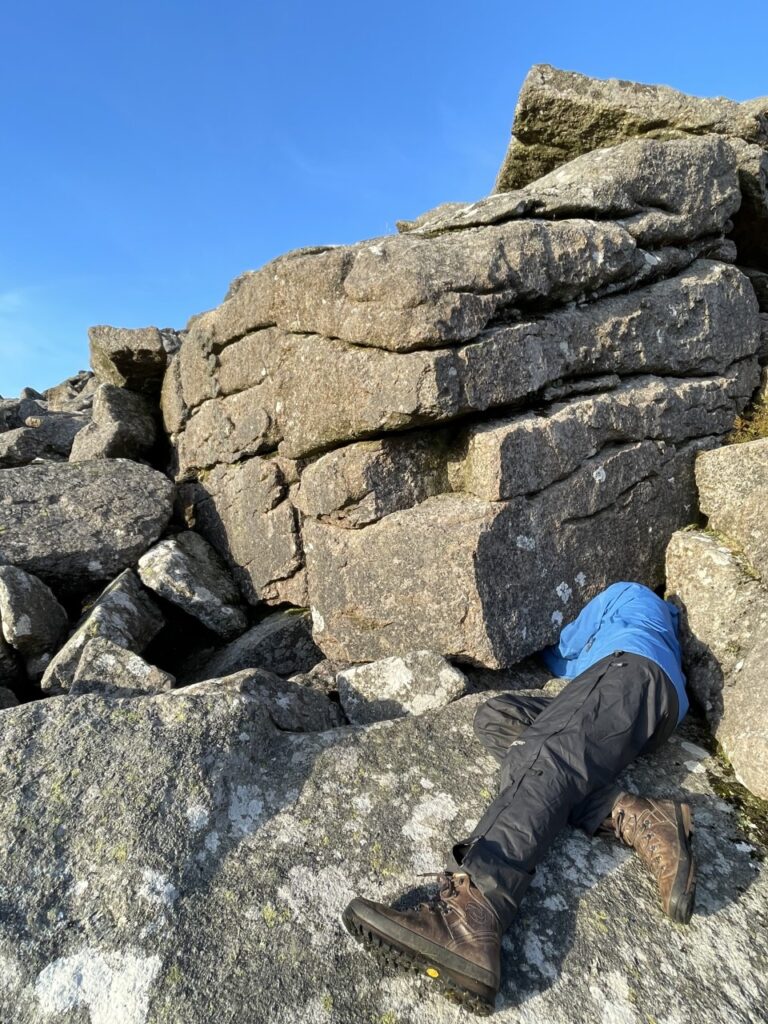
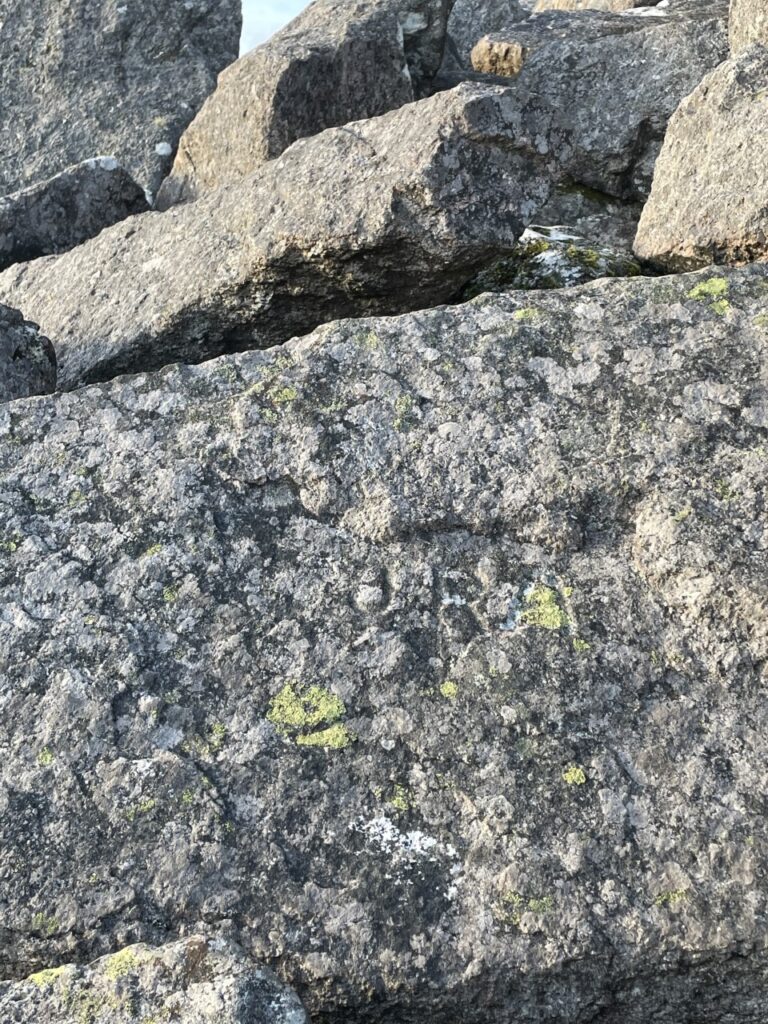
Acknowledgement: Pointed out by Paul Rendell on a walk with Max Piper on 2nd September 2022. Is this a lintel for a door at the possible corn mill?